Power Factor Correction Savings - Use Our Free Calculator
On This Page:
- Introduction
- Why Power Factor Affects Your Electricity Costs
- The Three Numbers You Need From Your Electricity Bill
- Your current power factor
- Your peak demand in kVA
- Your demand charge rate ($/kVA/month)
- How the Calculation Works
- How PFC Units Saved DAMOS Manufacturing Over $1m
- What Affects the Cost and Payback
- Network tariff trends
- Harmonic levels on your site
- Load variability
- Savings beyond demand charges
- Estimate Your Sites Savings With Our PFC Calculator
- More Australian Businesses Saving with PFC
- Why an Estimate Is a Starting Point
- Get an Accurate Savings Figure for Your Site
If your electricity bill includes kVA demand charges and your power factor sits below 0.95, you are paying more than you need to. Power factor correction equipment reduces these charges by improving the efficiency of your electrical system. For most commercial and industrial sites in Australia, the investment pays for itself within 18 to 24 months.
But how do you work out the exact payback for your site? This guide walks through the calculation step by step, so you can build a business case for power factor correction with real numbers. We have also built a free power factor correction savings calculator you can use right now.
Why Power Factor Affects Your Electricity Costs
When your power factor is low, your electrical system draws more current than it needs to do the same amount of work. This excess current shows up on your electricity bill as higher kVA demand, and your network operator charges you for every kVA of demand your site records.
The relationship is simple. A site drawing 375kW of real power with a power factor of 0.75 will register demand of 500kVA. Improve that power factor to 0.98 and the same 375kW of real power only registers 383kVA. That 117kVA reduction translates directly into lower demand charges every month.
The lower your power factor, the bigger the gap between what you need and what you are paying for, and the bigger the savings when you correct it.
The Three Numbers You Need From Your Electricity Bill
Before running any savings calculation, you need three figures from your electricity bill or your most recent power quality audit report.
Your current power factor
Power factor measures how efficiently your electrical system uses the power it draws from the grid. A power factor of 1.0 means perfect efficiency. Most sites with power quality issues sit somewhere between 0.65 and 0.85. Your network operator or energy retailer may include this figure on your bill. If not,
a power quality audit, or allowing Quality Energy to access the site's interval meter data from your energy retailer will establish it.
Your peak demand in kVA
This is the maximum apparent power your site draws from the network. It appears on your bill as "maximum demand" or "peak demand." When your power factor is low, this number is higher than it needs to be.
Your demand charge rate ($/kVA/month)
This is the dollar amount your network operator charges per kVA of demand each month. It varies between distribution network service providers and tariff classes. In Australia, rates range from $5 to $23 per kVA per month, though some regional networks charge more. Your network operator is listed on your electricity bill.
How the Calculation Works
The core formula calculates how much kVA demand you can eliminate by raising your power factor, then multiplies that reduction by your demand charge rate.
kVA Reduction = Current kVA − (Real Power in kW ÷ Target Power Factor)
Annual Savings = kVA Reduction × Demand Rate × 12 months
Payback Period = System Cost ÷ Annual Savings
Rather than walking through abstract numbers, here is what this looks like with real figures from a Quality Energy installation.
How PFC Units Saved DAMOS Manufacturing Over $1m
David Moss Corporation (DAMOS) manufactures PE and PVC pipe and fittings for the mining, industrial, and agricultural sectors at their facility in Geebung, Queensland.
DAMOS needed to install additional electrical equipment, but their existing infrastructure could not support the increased load. The conventional solution was a transformer upgrade costing over $350,000. Instead, DAMOS contacted Quality Energy to explore an alternative.
Quality Energy installed power quality monitors on the site and, after analysing the data, identified that the facility's power factor was an extremely low 0.63.
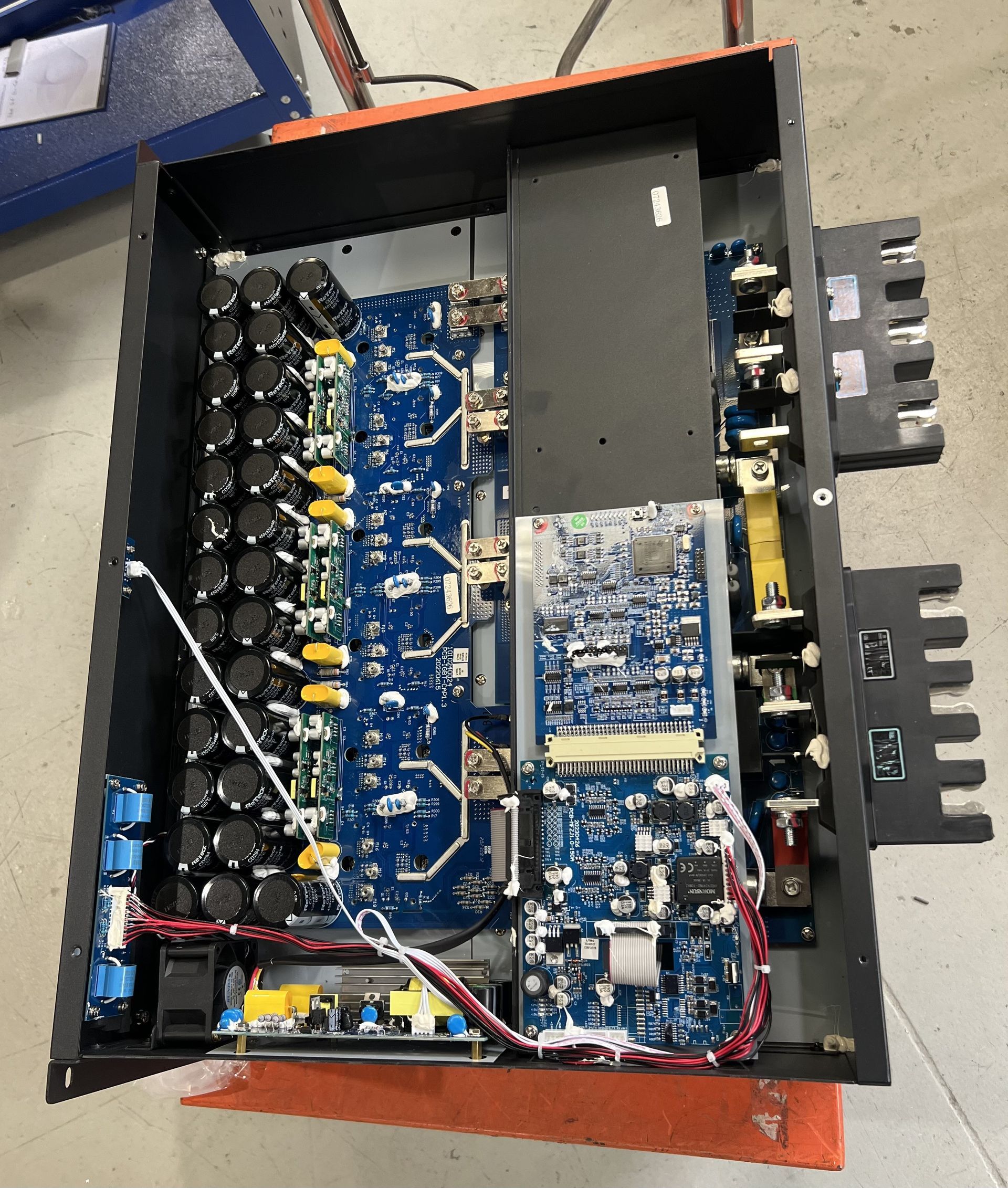
The solution: Two custom-built PFC units totalling 1,700kVAr (a 900kVAr unit for the west switchboard and an 800kVAr unit for the east switchboard), designed, manufactured, delivered, installed, and commissioned by Quality Energy.
The results:
| Metric | Before PFC | After PFC |
|---|---|---|
| Power factor | — | 0.99 |
| Current reduction | — | ~1,300 Amps across both boards |
| Monthly demand charge savings | — | $8,500+ |
| System payback period | — | 18 months |
| Transformer upgrade avoided | $350,000 | Not required |
At $8,500 per month in demand charge savings, the 18-month payback means DAMOS invested approximately $150,000 in power factor correction equipment. The alternative was a $350,000 transformer upgrade that would have delivered zero ongoing savings.
Over a 10-year period, the demand charge savings alone total over $1,000,000. Add the $197,000 saved by avoiding the transformer upgrade and the total benefit exceeds $1.2 million. DAMOS was also able to move forward with installing new equipment without the risk of tripping their power supply, which was the original trigger for the project. Find the
full case study here.
What Affects the Cost and Payback
System costs vary significantly depending on the kVAr capacity required, cabinet configuration, harmonic environment, and commissioning. A smaller commercial site needing 100 to 200kVAr will have a very different investment profile to a large industrial facility requiring 1,000kVAr or more. As a rough guide, installed costs range from $45 to $90 per kVAr depending on system size and site requirements, with larger systems generally achieving a lower cost per kVAr.
Other influences on the payback period:
Network tariff trends
kVA demand tariffs have been trending upward across most Australian networks. When CitiPower moved to kVA billing, businesses like the
University of Melbourne saw immediate increases in their electricity charges. Calculating ROI at today's rates is conservative because future rates are likely to be higher.
Harmonic levels on your site
If your facility has high harmonic distortion from variable frequency drives, UPS systems, or other non-linear loads, standard capacitors in PFC equipment can be damaged over time. This means the PFC system may rely on its detuning reactors to protect the capacitors, or in cases of higher harmonic distortion, an Active Harmonic Filter may be recommended alongside the PFC unit to address both issues. Alternatively, using a static var generator which is not affected by harmonics might be the most cost effective option.
Quality Energy manufactures both solutions in-house, so the system can be designed as a combined package tailored to your site's conditions. A power quality audit will determine whether harmonics are present and what protection is required.
Load variability
Sites with highly variable loads benefit from automatic PFC systems that adjust capacitor stages in real time. Automatic systems cost more than fixed correction but deliver better results because they respond to changing load conditions. Quality Energy's MOD range is designed for these applications.
Savings beyond demand charges
The calculation only accounts for demand charge reductions. Improving your power factor also reduces line losses in your internal distribution system, lowers cable heating, extends equipment life, and can
free up transformer capacity, as the DAMOS project demonstrated. These benefits improve the overall return but are harder to quantify without a site assessment.
Estimate Your Sites Savings With Our PFC Calculator
The calculator uses indicative demand charge rates based on published network tariff schedules for major Australian DNSPs. Your exact rate may differ depending on your tariff class and connection type. For a precise figure, check your bill for the exact $/kVA charge or contact your energy retailer.
Power Factor Correction
Payback Estimator
Estimate how quickly a PFC system could pay for itself based on your site's demand profile and network tariff.
Your Site Details
Adjust the sliders to match your facility. You can find these figures on your electricity bill or from your last power quality audit.
How Your Savings Break Down
Long-Term Return Projection
About This Estimate
This calculator provides an indicative estimate based on standard engineering formulas for reactive power compensation. The system cost estimate is based on typical pricing for Australian-manufactured PFC equipment and will vary depending on your site's requirements, cabinet configuration, and installation complexity.
The formula: kVAr required = √(kW²/PF₁² − kW²) − √(kW²/PF₂² − kW²), where PF₁ is your current power factor and PF₂ is your target.
For an accurate assessment of your site's power quality and a precise savings calculation, a power quality audit is recommended. This involves installing monitoring equipment on your switchboard for 7 to 14 days to capture your actual load profile, harmonics, and power factor across all operating conditions.
Want an Accurate Savings Figure?
A power quality audit captures your site's real load profile and gives you an exact savings calculation, not an estimate. Most businesses see payback within 12 to 24 months.
Book a Power Quality Audit →More Australian Businesses Saving with PFC
The DAMOS project is one example, but the pattern repeats across industries and states.
Bulla Dairy Foods needed to reset peak demand charges at their facility. Quality Energy delivered a complete power quality upgrade including custom PFC equipment, reducing demand charges and protecting production equipment. Read the Bulla case study here.
SunRice identified poor power factor as the cause of surging energy costs. They needed a 900kVAr outdoor-rated system with an 1800A main switch. Quality Energy designed and installed two triple-door, outdoor-rated IP56 PFC units. Learn more in our SunRice case study.
Sugar Australia processes over 500 tonnes of refined sugar each year. Heavy processing equipment was causing poor power factor across the facility. Quality Energy manufactured custom power quality equipment to bring the site back into efficient operation. Learn more about how we corrected the power factor from 0.83 to 0.98 for Sugar Australia.
Visy Industries has partnered with Quality Energy for over 20 years to reduce electrical demand across their national operations, delivering sustained savings through PFC equipment and active harmonic filters. This combination reduced the operating temperature of their MSP3 from 105°C to 59°C.
Why an Estimate Is a Starting Point
The calculator and the methodology above give you a solid figure for building an internal business case. However, they are based on assumptions about your load profile that may not reflect how your site operates throughout the day, week, or season.
A power quality audit captures your site's real electrical behaviour over 7 to 14 days. Monitoring equipment records power factor, demand, harmonics, voltage, and current at intervals throughout the period. This data allows Quality Energy's engineers to design a PFC system tailored to your load profile rather than relying on bill data alone. It also identifies whether harmonics, voltage issues, or other power quality problems are present that would affect the system design.
The audit report includes an exact savings calculation based on your real data, a system specification, and a formal quote. For most sites, the audit confirms that the savings are as good as or better than the estimate, because bill data often understates peak demand events that drive up costs.
Get an Accurate Savings Figure for Your Site
Contact Quality Energy to discuss your site's requirements and whether Power Factor Correction Equipment could be right for you. Our team will install monitoring equipment, analyse your data, and provide a detailed savings report with a system specification and quote.
Related news