The Power Quality Risks in Industrial Electrification
On This Page:
- Introduction
- Why Industrial Electrification Is Accelerating
- The Power Electronics Inside Modern Industrial Equipment
- Industrial Heat Pumps
- SCR-Controlled Electric Boilers
- Induction Heating Systems
- Mechanical Vapour Recompression
- Depot Charging and Battery-Electric Materials Handling
- Why Electrification Projects Miss This at Design Stage
- Designing Mitigation Into Electrification Projects
- Active Harmonic Filters in Electrification Projects
- Conclusion
Australian manufacturers, food processors, hospitals, and logistics operators are undergoing significant electrical infrastructure change. Industrial electrification, the systematic replacement of fossil-fuelled equipment with electric alternatives, is being driven by sustained gas market pressure, federal and state decarbonisation funding, and corporate net-zero commitments.
The transition spans multiple equipment categories. Gas-fired boilers and ovens are being replaced with industrial heat pumps and electric boilers. Gas furnaces are moving towards induction systems. Diesel forklifts and yard equipment are being phased out for battery-electric models. Depot-scale charging infrastructure is being installed for electric trucks and buses.
Most electrification feasibility studies overlook a critical engineering issue: almost every category of equipment driving this transition is a non-linear electrical load. Heat pumps, electric boilers, induction systems, EV chargers, and battery-electric materials handling all rely on power electronic converters. The problem is, power electronics inject harmonic distortion onto the supply.
For sites planning electrification at any scale, harmonic distortion belongs on the project risk register at the design stage. We find many buildings needing to retrofit this after equipment fails prematurely or tenants report flickering lights and tripping breakers.
Why Industrial Electrification Is Accelerating
Process heat accounts for approximately 52% of energy used by Australian industry and around 20% of national end-use energy. Most of this heat is currently generated by burning natural gas. With commercial and industrial gas prices increasing and southern-state supply tightening in 2026, fuel switching has shifted from a long-term decarbonisation aspiration to an immediate operating cost decision.
The funding environment is unprecedented:
- The Australian Renewable Energy Agency (ARENA) opened Round 3 of its Powering the Regions Industrial Transformation Stream in September 2025, targeting electrification of fossil-fuelled process heat including heat pumps, mechanical vapour recompression, electric boilers, infrared, induction, and microwave technologies.
- The Future Made in Australia Innovation Fund launched in December 2025 with up to $1.5 billion available for low-emissions deployment, including industrial heat as a priority area.
- The Australian Industry Renewable Heat Accelerator (AIRHA), delivered with the Australian Alliance for Energy Productivity (A2EP), confirmed 13 funded projects in late 2025 across food and beverage, pulp and paper, bricks and concrete masonry, smallgoods manufacturing, food oils refining, commercial healthcare laundries, and rendering plants. Participants include GrainCorp, George Weston Foods, Wingham Beef, and Linen Services Australia.
- State programs include Queensland's Transforming Queensland Manufacturing Grants Program (matched grants up to $1.5 million) and the NSW Government's $40 million commitment to industrial emissions reduction in mining and manufacturing.
Fleet electrification is moving through the same industrial sites in parallel. Logistics depots, distribution centres, council works yards, and food production sites are installing depot charging infrastructure. Process heat is the largest harmonic-injecting category but rarely the only electrification project on a given site, which compounds the cumulative power quality impact.
The supporting technologies are commercially established. High-temperature industrial heat pumps deliver process water and steam above 90°C, with cascade systems reaching 150°C to 165°C.
Electrode boilers and SCR-controlled resistance boilers are available at megawatt scale. Induction heating is replacing gas furnaces in metals and food applications. Mechanical vapour recompression is being deployed in evaporation and distillation duties.
ARENA estimates industrial heat pumps alone could displace more than 5 petajoules per annum of natural gas use in the manufacturing sector, equivalent to over 255,000 tonnes of CO₂ per year.
What ties these technologies together, and what most electrification feasibility studies fail to address, is that they are non-linear electrical loads.
The Power Electronics Inside Modern Industrial Equipment
A traditional gas boiler imposes minimal load on a site's electrical infrastructure. Thermal energy comes from combustion, with electrical demand limited to the burner, control system, and feed water pump. The same applies to a diesel forklift or LPG-fired oven.
Replacing these systems with electric alternatives changes this. Energy that previously came from a flame or fuel tank now flows through a power electronic converter. Each converter type produces its own harmonic signature.
Industrial Heat Pumps
High-temperature industrial heat pumps use variable speed compressors to modulate output and maintain efficiency across changing load conditions. These compressors are driven by variable frequency drives (VFDs), generally using a six-pulse rectifier topology that draws non-sinusoidal current from the supply.
The harmonic content is well documented: dominant 5th and 7th harmonics, plus 11th, 13th, and higher orders. A standard six-pulse VFD with a 3% line reactor typically produces current total harmonic distortion (THDi) of 35–38%, with unmitigated values substantially higher. Read our post on IEEE-519 compliance for more detail on this.
This was manageable when VFDs were sized for individual pumps and fans drawing tens of kilowatts. It becomes a significantly larger problem when the VFD feeds a compressor on a 500kW or 1MW heat pump replacing a steam boiler.
The issue compounds in food and dairy applications, where multiple large heat pumps operate in parallel and harmonic currents from each unit superimpose at the point of common coupling.
SCR-Controlled Electric Boilers
Electric resistance boilers and thermal heaters are commonly controlled by silicon-controlled rectifiers (SCRs, also called thyristors) to modulate output. SCR controllers operate in one of two modes, and the choice has significant power quality implications.
In phase-angle firing, the SCR conducts for only part of each AC half-cycle, allowing fine power resolution. This produces precise process control but generates substantial harmonic content, radio frequency interference, and a power factor that drops sharply at partial load.
Industry data indicates power factor on phase-angle SCR systems can fall to approximately 0.7 at 50% output and as low as 0.5 at 25% output, with rising harmonic distortion at the part-load conditions where many industrial heating systems spend most of their operating time.
Burst firing (zero-crossing control) switches full cycles on and off rather than chopping each cycle. It produces cleaner waveforms but compromises temperature control precision.
When tight temperature regulation is required, such as pharmaceutical sterilisation, glass annealing, certain food applications, phase-angle firing is often the only viable option. In these cases,
harmonic mitigation is not optional, it becomes a requirement of the installation.
Induction Heating Systems
Industrial induction systems used for melting, forging, hardening, and increasingly for replacing gas-fired ovens in food production rely on high-frequency converter stages that draw heavily distorted current from the supply.
Induction furnaces are aggressive non-linear loads. They produce harmonic distortion across a wide spectrum of orders and, because power demand changes rapidly during the melt cycle, also cause voltage fluctuations and flicker that affect adjacent equipment and other tenants on the same network. The same physics applies, at a smaller scale, to insulated gate bipolar transistor (IGBT) based induction systems deployed in commercial kitchens and food manufacturing.
Mechanical Vapour Recompression
Mechanical vapour recompression (MVR) is increasingly specified in evaporation, distillation, and concentration duties as an alternative to steam-driven processes. Like industrial heat pumps, MVR systems use VFD-driven compressors and present the same harmonic profile to the upstream network.
Depot Charging and Battery-Electric Materials Handling
Fleet electrification adds a different harmonic load category to the same sites. DC fast chargers for trucks, buses, and vans contain large rectifier stages drawing distorted current from the supply, and depot installations often run multiple chargers in parallel during charging windows.
Battery-electric forklifts and yard equipment compound the issue with onboard chargers operating throughout the working day.
The harmonic profile of a charging hub differs from a heat pump or SCR boiler. It peaks during specific operating windows rather than running continuously. The impact on overall site total harmonic voltage distortion (THDv) at the point of common coupling is significant, and is rarely modelled together with the thermal electrification load it shares a switchboard with.
The pattern repeats across technology infrastructure too: virtually every modern, efficient, controllable piece of industrial equipment is built around power electronics. Power electronics inject harmonics.
Why Electrification Projects Miss This at Design Stage
When engineers and ESCOs scope an industrial electrification project, the electrical workstream usually focuses on three questions:
- Whether the existing transformer and main switchboard can carry the new load
- Whether the network connection agreement requires amendment; and
- Whether the site has sufficient physical space and ventilation.
Harmonic impact is rarely included. Sites audited after commissioning frequently show that the harmonic profile of new heat pump, electric boiler, or depot charging installations was never modelled, even on multi-million-dollar projects with tier-one consulting engineers attached. The assumption is often that AS/NZS 61000.3.6 compliance is the equipment supplier's responsibility, when in practice the standard governs impact at the point of common coupling. Compliance depends on the harmonic contribution of the new load combined with all existing site loads and the network's source impedance.
The result follows a recognisable pattern. New equipment is commissioned. Within weeks or months, the site begins experiencing symptoms not present previously: nuisance tripping on adjacent circuits, transformer hum, premature failure of variable speed drives that previously ran without issue, complaints from sensitive process equipment, and, for sites with tenants or co-located operations, escalating reports of flickering lights and IT equipment glitches.
A
power quality audit at this stage often shows total harmonic voltage distortion well above AS/NZS 61000.3.6 planning levels, with the new electrified load identified as the dominant contributor. Retrofit mitigation is then required.
Designing Mitigation Into Electrification Projects
Harmonic distortion is a well-understood engineering problem with established solutions. The economic case for industrial electrification remains independent of mitigation cost, which represents a small fraction of total project capex. The critical factor is sequencing: mitigation works best when designed in, rather than retrofitted.
Establish a baseline before the new load arrives. A pre-electrification power quality audit captures the site's current harmonic profile, including contributions from existing VFDs, UPS systems, switch-mode power supplies, and lighting. This becomes the reference point for modelling new equipment impact and establishes whether the site is already approaching limits.
Model the post-conversion harmonic profile. Once equipment selection is finalised, the expected harmonic spectrum can be combined with existing site load and network impedance to predict THDv at the point of common coupling. This determines the mitigation strategy: low-harmonic equipment specification, active harmonic filter sizing, or both.
Specify mitigation as part of the electrical scope. Active harmonic filters integrate cleanly with new switchgear when included in the original design. Adding them after commissioning can require switchboard modification, additional outage windows, and cable management rework.
Plan for capacity headroom. Sites that electrify one load typically electrify others within a few years. For example, a heat pump now, a depot charger next year, an induction line subsequently. An active harmonic filter sized only for the first project will require replacement or supplementation as additional loads come online. Sizing initial mitigation with growth headroom is generally a marginal capex decision that pays for itself with the second electrification project.
Active Harmonic Filters in Electrification Projects
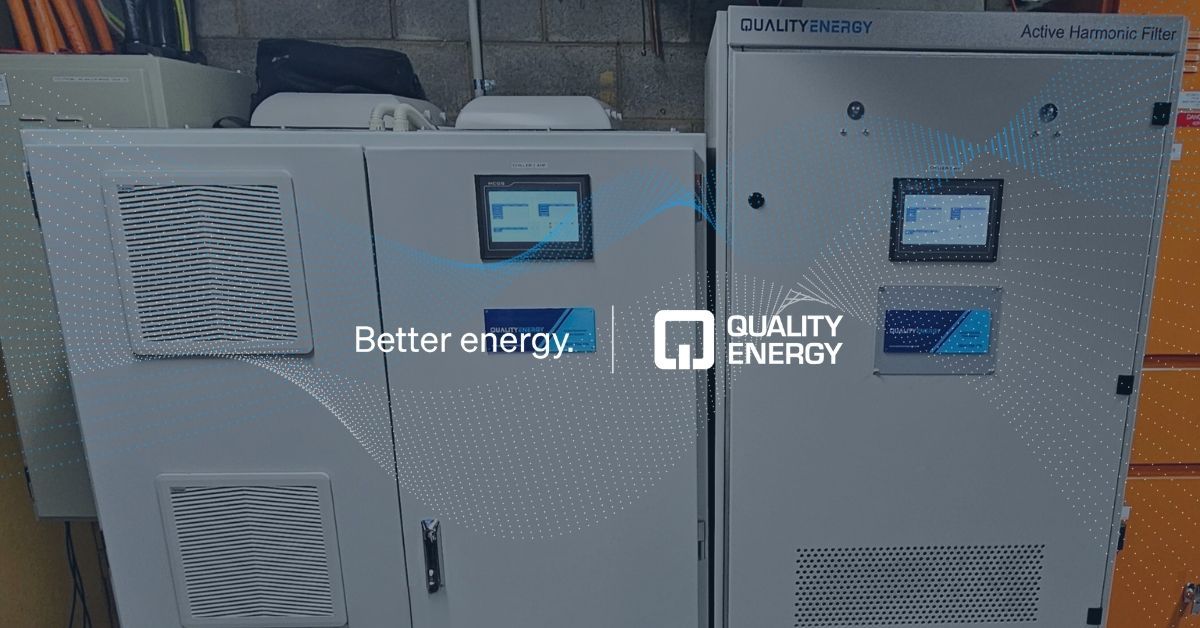
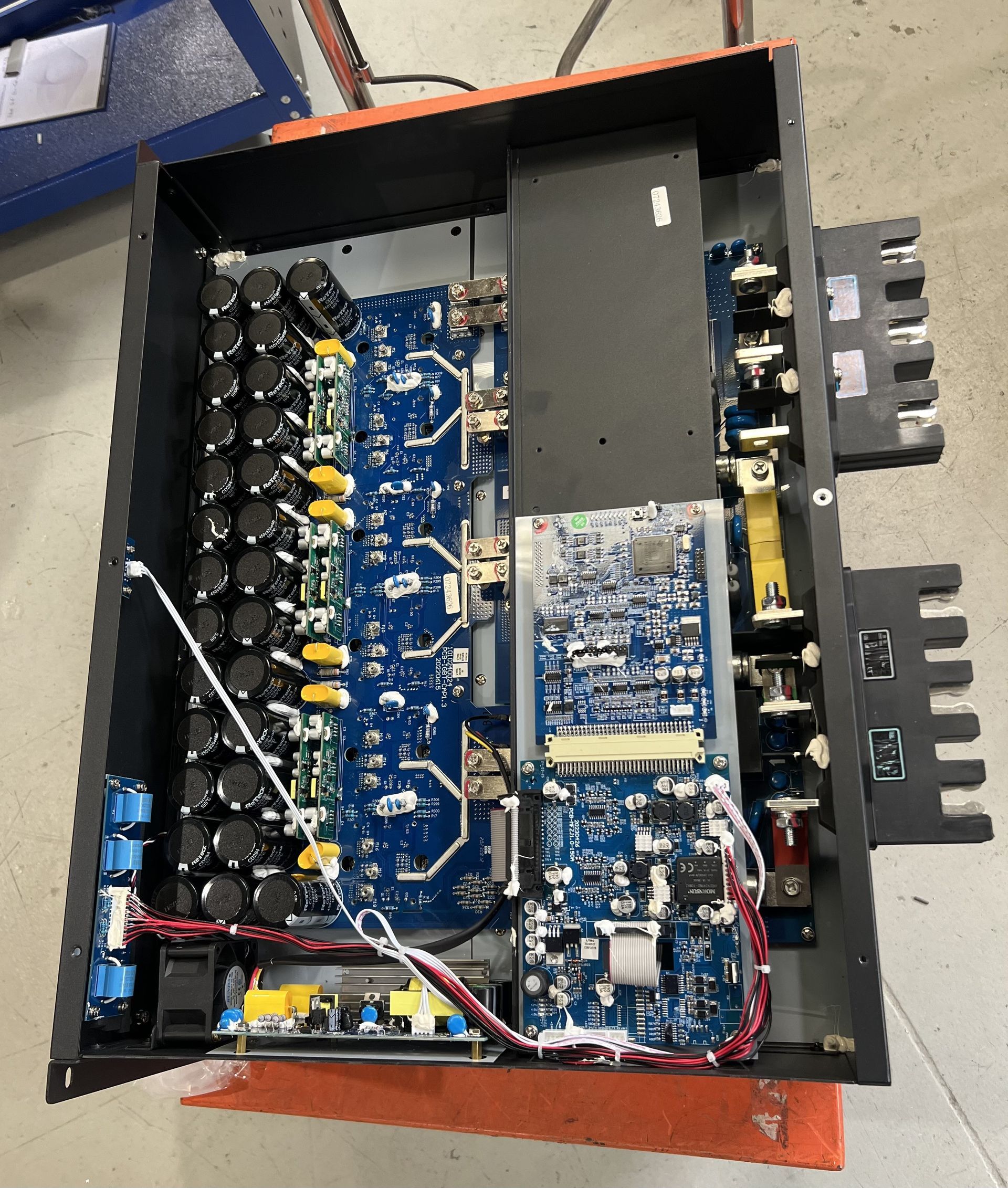
Quality Energy's Active Harmonic Filters are designed for this application. They monitor current harmonics on the supply in real time and inject equal-and-opposite compensating currents to cancel distortion at source. Unlike passive filters, they adapt automatically to changing load conditions, which is essential when the harmonic profile of a heat pump, SCR boiler, or charging hub varies continuously through the operating day.
For industrial electrification projects, integration follows a defined sequence. Quality Energy engineers complete a power quality audit during the design phase, model the harmonic impact of the proposed load, and custom build an AHF sized for the post-conversion profile with capacity headroom for future loads.
The filter is manufactured at our Moorabbin facility, factory tested, and commissioned alongside the new equipment as part of a single electrical works package. Compliance with AS/NZS 61000.3.6 and IEEE 519 is verified on energisation, with ongoing maintenance provided under the same servicing agreement as the rest of the site's power quality infrastructure.
The outcome is an electrification project that delivers the operating cost savings, emissions reduction, and productivity gains specified in the business case.
Conclusion
Australian industry will continue to electrify. The combination of gas market pressure, federal funding, state programs, and corporate decarbonisation commitments has established the direction. What remains decided project by project is whether each electrification protects or degrades the site's electrical infrastructure.
For facility managers, plant engineers, ESCOs, and consulting engineers planning industrial electrification work in the next 12 to 24 months, harmonic distortion should be treated as a first-order design input. Establish a power quality baseline before the new load arrives. Model the impact. Specify mitigation alongside the equipment.
To discuss the harmonic implications of an electrification project before equipment is ordered, contact Quality Energy's technical team on 1800 736 374 or arrange a power quality audit of your existing site.
Related news