Commercial Solar Rebate Over 100kW: The 2026 SRES Expansion Explained
On This Page:
- Introduction
- What is Changing Under the 2026 SRES Expansion?
- How Does a Commercial Solar Rebate Work for Systems Over 100kW?
- Why is the Commercial Solar Threshold Being Increased?
- Where the 2026 Mid Scale Solar Incentive May Have the Greatest Value
- Manufacturing and processing facilities
- Warehouses and logistics centres
- Farms and agricultural businesses
- Schools, hospitals and community facilities
- Make the Most of the Larger Rebate With Careful Project Planning
- Frequently Asked Questions
- Can an existing commercial solar system be expanded?
- What happens to projects already accredited under the LRET?
- How much could the mid-scale solar incentive be worth?
- Book Your Solar Feasibility Study With Quality Energy
Australian businesses planning solar above 100 kW may soon receive a much larger upfront discount. Under proposed commercial solar rebate changes coming into effect 1 October 2026, eligible systems with more than 100 kW and no more than 1 MW of total onsite capacity can now create small-scale technology certificates offsetting upfront costs.
The Australian Government estimates that the change could reduce the upfront cost of eligible commercial, industrial and agricultural solar projects by around 20%. It would also give many mid-scale projects access to an upfront certificate benefit instead of relying on large-scale generation certificates earned over time.
This guide explains the Small-scale Renewable Energy Scheme expansion, how STCs for 1MW solar may work, which projects are expected to qualify and what businesses should assess before committing to a system.
What is Changing Under the 2026 SRES Expansion?
The Small-scale Renewable Energy Scheme currently supports solar PV systems with a capacity of no more than 100 kW. Systems above that limit needed to seek accreditation under the Large-scale Renewable Energy Target (LRET) to create large-scale generation certificates (LGCs). This saw many commercial solar installations capped at ~99 kWh to maximise the upfront rebates available.
On 5 August 2026, the Australian Government announced that it intends to expand the SRES to commercial solar installations above 100 kW and up to 1 MW. The proposed commencement date is 1 October 2026, subject to the required regulations being in place.
The change creates a mid-scale solar incentive for the group of projects between small commercial rooftop systems and larger industrial installations above 1 MW. These systems are often suited to factories, warehouses, shopping centres, logistics facilities, farms, schools, hospitals and community buildings.
The main proposed settings are:
- New Solar PV systems must have more than 100 kW and no more than 1 MW of total onsite capacity.
- An expansion to an existing solar system must keep the site's combined capacity at no more than 1 MW.
- Eligible projects would create STCs using a five-year deeming period.
- The five-year period would apply to eligible mid-scale systems installed in each year through to the end of the SRES in 2030.
- Existing mid-scale systems accredited under the LRET would remain within that scheme.
- New systems above 1 MW would continue to seek support through the LRET.
How Does a Commercial Solar Rebate Work for Systems Over 100kW?
The SRES works like an upfront discount on the capital cost of a solar project, rather than a rebate paid to your business after installation.
An eligible solar system creates Small-scale Technology Certificates, or STCs. At Quality Energy, we handle the certificate generation and deduct the agreed value from the project price. Your procurement team will see this as an STC discount in the quotation.
Each STC represents one megawatt hour of renewable electricity the system is expected to generate during the applicable deeming period. Under the proposed mid-scale solar rules, eligible systems would receive STCs based on five years of expected generation. This fixed five-year period would apply to systems installed in each eligible year through 2030. If the proposal proceeds, a qualifying system installed closer to 2030 would not receive a shorter deeming period simply because it was installed later.
This treatment differs from the existing SRES schedule for systems up to 100 kW, where the deeming period falls by one year annually. The STC price is set by the certificate market. Open-market prices can change with supply and demand, while the STC Clearing House price is capped at $40 excluding GST. For this reason, a proposal should state the assumed certificate price and the net discount included in the quoted project cost.
Why is the Commercial Solar Threshold Being Increased?
Australia has installed far more rooftop solar on homes than on business premises. In a recent media release, the government reported about 22 GW of residential solar compared with around 5.6 GW installed by businesses, with much of the business capacity in systems below 100 kW.
The Clean Energy Regulator also reported a fall in mid-scale registrations during the first half of 2026. Eighty power stations between 100 kW and 1 MW, representing 28 MW of capacity, were accredited under the LRET during that period. That capacity was around 32% below the average for the first half of each year since 2021. The Regulator linked the reduction in part to declining LGC prices.
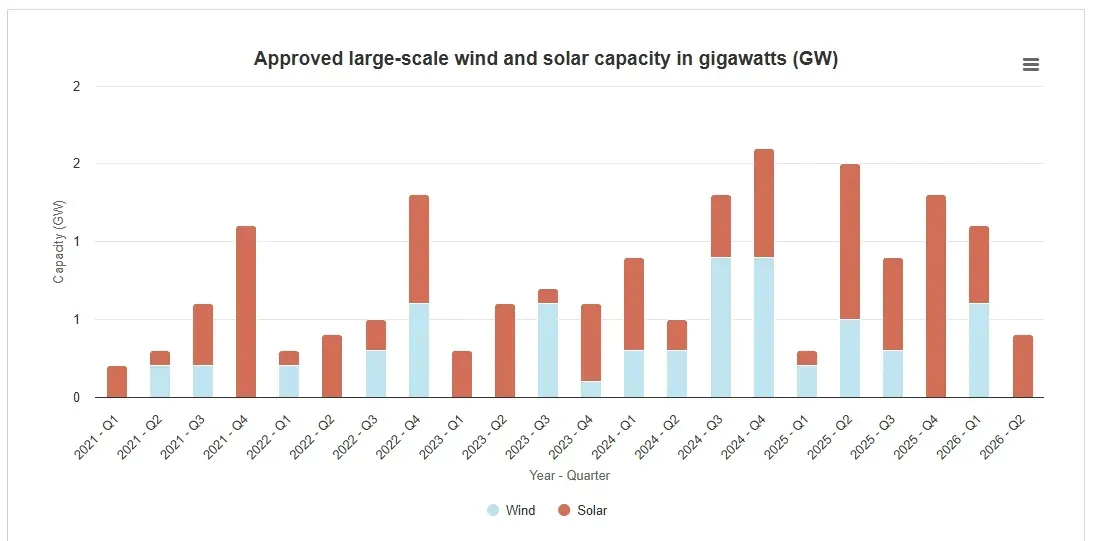
Source:
CER Market Report June 2026
The planned commercial solar rebate over 100kW is intended to address this. An upfront benefit can be easier to include in a capital approval than certificate revenue received after the system generates electricity. It may also reduce the administrative load associated with LRET accreditation, metering, annual reporting and ongoing LGC creation.
Network connection approval will still matter. The government has requested work on rule changes intended to improve connection processes for commercial and industrial solar, but the SRES announcement does not remove distributor studies, export limits, protection requirements, planning approvals or electrical safety obligations.
Where the 2026 Mid Scale Solar Incentive May Have the Greatest Value
The policy is likely to be most useful for sites with enough roof or ground area and strong daytime demand. High self-consumption allows the business to avoid more grid electricity, which is more valuable than exporting excess solar at a lower rate.
Manufacturing and processing facilities
A factory considering a 500 kW system may use a large share of the output across production lines, refrigeration, compressed air, ventilation and process equipment. The government's indicative $136,000 upfront discount could improve the capital case, but interval meter data is needed to test how much solar the site would use.
Warehouses and logistics centres
Large roofs can support substantial panel capacity, yet electricity demand varies widely between a basic storage facility and a temperature-controlled distribution centre. A 250 kW system may suit one site, while another can support a system closer to 1 MW. The load profile, tenant arrangements and network export capacity will guide the design.
Farms and agricultural businesses
Pumps, irrigation, cold storage, packing sheds, dairies and processing equipment can create useful daytime loads. Seasonal demand needs close attention. A design based only on annual electricity consumption can oversize the system for low-use months and overstate the financial return.
Schools, hospitals and community facilities
These sites may have large roofs and steady daytime electricity use. Project assessment should also consider weekend and holiday demand, backup requirements, site access, public safety and any heritage or planning restrictions.
Make the Most of the Larger Rebate With Careful Project Planning
There’s no denying the changes to commercial solar rebates will improve project economics, but system size should still follow the site's energy data and operational plans. A project designed to capture the largest certificate discount may export too much energy, face a costly network connection or underperform against its business case.
When you book a feasibility study with Quality Energy, we examine:
- Interval electricity data: At least 12 months of usage data can show daily and seasonal demand, peak loads and the likely level of solar self-consumption.
- Tariffs and avoided costs: Retail energy rates, demand charges, network tariffs and export payments affect the value of each generated kilowatt hour.
- Roof and site conditions: Structural capacity, available area, shading, access, switchboard condition, fire pathways and equipment locations influence the usable system size and project cost.
- Network connection: Export limits, protection settings, transformer capacity and distributor studies can affect timing, design and cost.
- STC assumptions: The deeming period, solar zone, certificate price, agent charges and who owns the certificates.
- Future demand: Electrified heating, cooling, machinery, fleet charging, production growth and battery storage can change what solar capacity is required.
- Procurement and finance: An outright purchase, equipment finance, lease or power purchase agreement can produce different cash flow, tax and certificate outcomes.
Solar installations of this size commonly take at least eight months to move from design to approval. Businesses considering the 2026 SRES expansion should begin the technical and network work early, even if installation will occur after the intended commencement date.
Get in touch with our team today to get the process started.
Frequently Asked Questions
Can an existing commercial solar system be expanded?
The proposal allows expansions where the combined onsite solar capacity remains no more than 1 MW and the project meets the final eligibility rules. Existing panels that have already received certificates cannot be claimed again.
What happens to projects already accredited under the LRET?
Existing accredited mid-scale systems will remain under the LRET and continue to create LGCs under the current arrangements. The announced change does not move those systems into the SRES.
How much could the mid-scale solar incentive be worth?
It is expected the SRES expansion 2026 will reduce the upfront installation cost of eligible solar installations by around 20%.
Book Your Solar Feasibility Study With Quality Energy
The proposed changes could improve the business case for warehouses, factories, farms, processing plants and other sites that need more than 100 kW of solar. The available incentive is only one part of the investment decision. System size, self consumption, demand charges, network costs, power quality and future battery requirements also affect the return.
Quality Energy brings more than 35 years of commercial and industrial electrical experience to solar and battery projects. Our team can review your interval data, site infrastructure and operating requirements, then model an appropriate solar or combined solar and battery system.
Book a feasibility study to assess the proposed system capacity, connection requirements, expected energy savings, available certificate support and estimated financial return for your business.
Related news